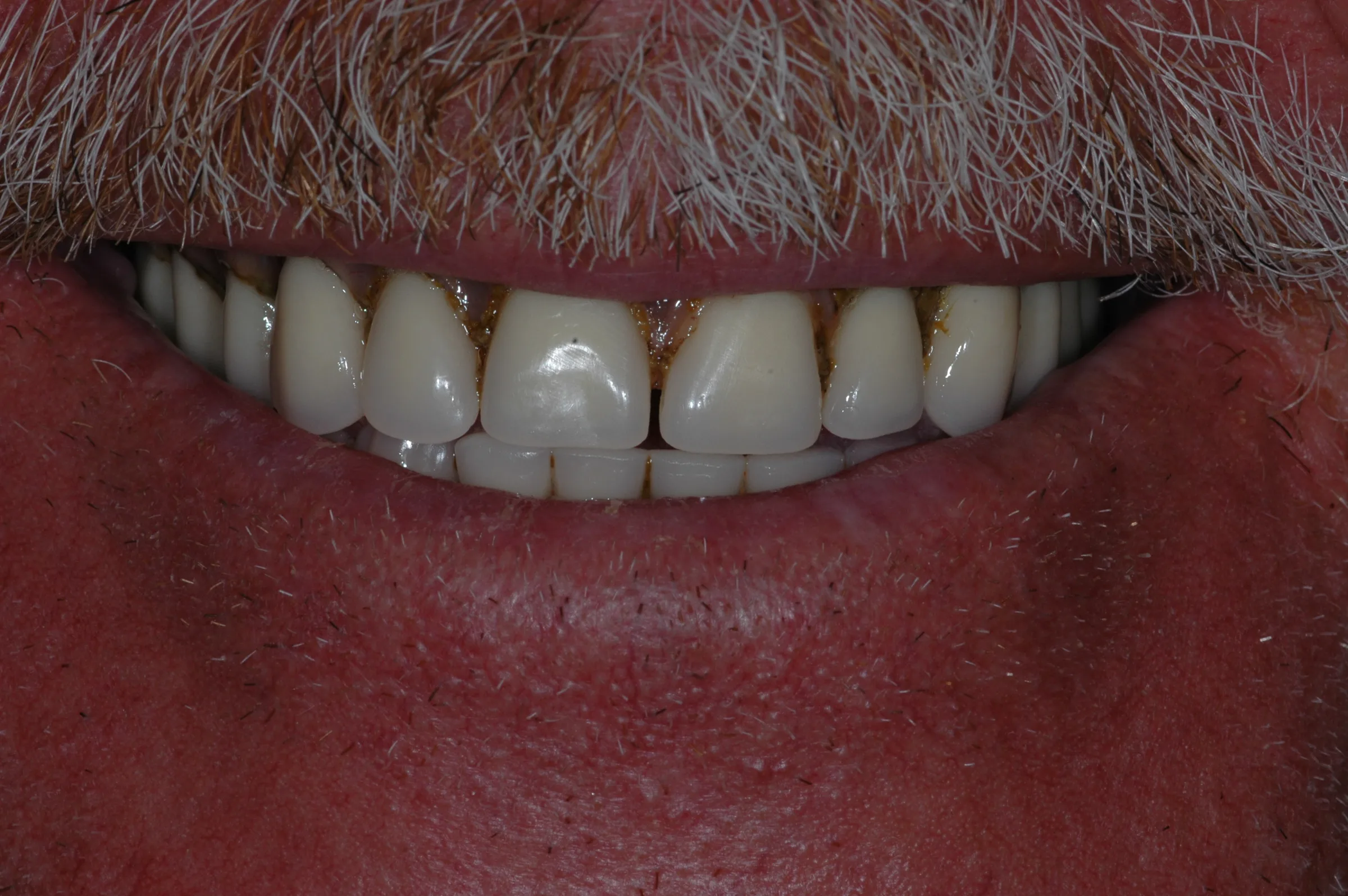
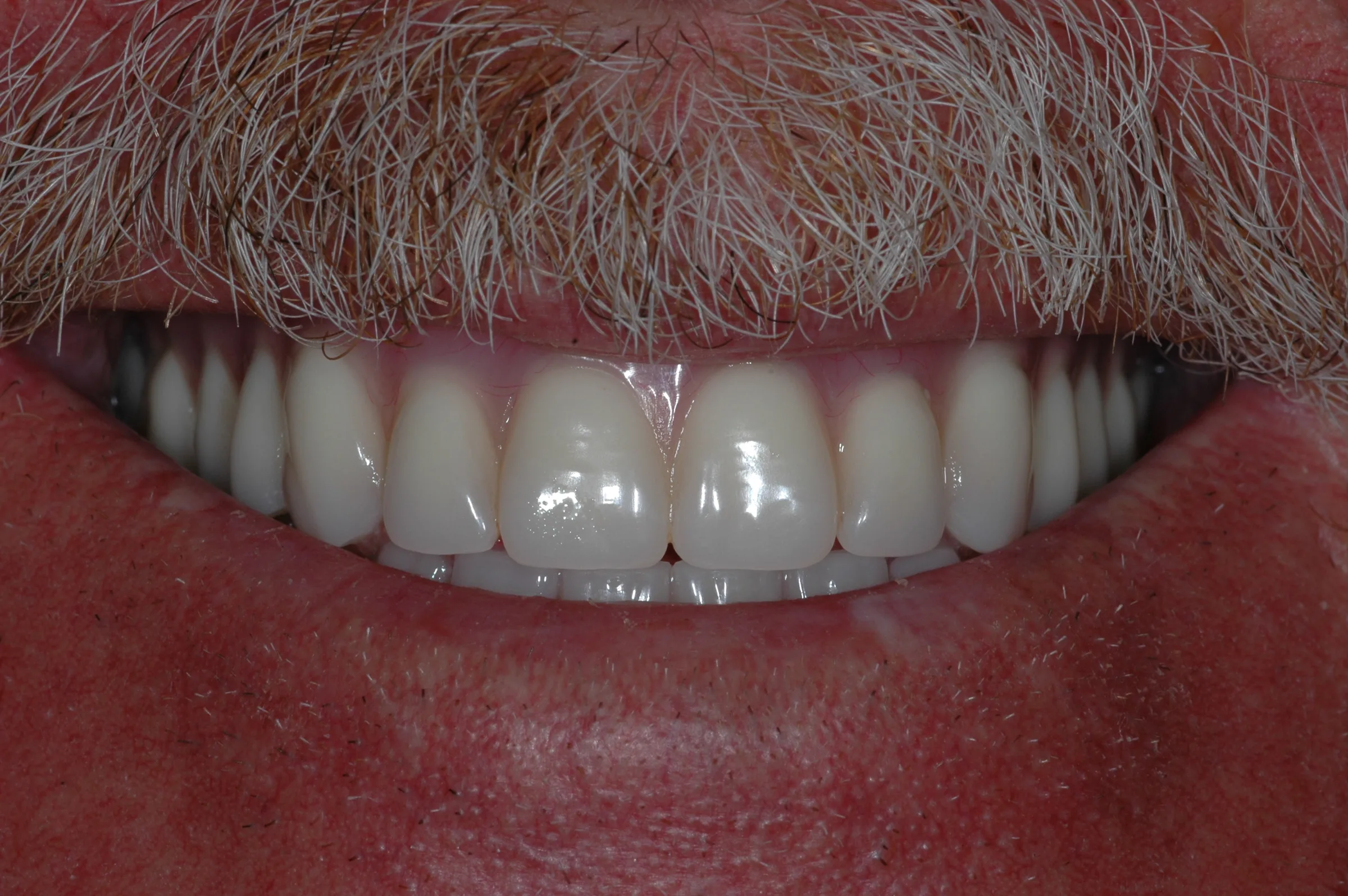
Replacement Set With Implants
Patient had old stained dentures that no longer looked or fit right. A new denture set was made, with dental implants placed to retain the lower denture — restoring both appearance and stability.


Easy-To-Maintain, Economical
A full set of teeth, stabilized by as few as two dental implants. Easy to remove for cleaning, but stays put for chewing, talking, and everyday life.
A Denture That Stays Securely in Place
If your lower denture moves when you chew, slips when you laugh, or makes you avoid certain foods, you're not alone. The lower jaw doesn't have enough ridge to hold a conventional denture the way the upper does — that's an anatomy problem, not a fit problem — and even a well-made lower denture can feel insecure.
"Dental implants have made a lot of difficult situations easier to solve," says Dr. Andrus. "For example, many people have a hard time keeping dentures in place. Because of the shape of their jaw and various other things, the denture may slip around when eating or talking — this is especially true of lower dentures. Using implants, we solve that problem with snap-on dentures."
If a patient needs full upper or lower teeth replacement, or has a denture that is loose, painful or makes them feel insecure, a snap-on denture may be the perfect solution.
A snap-on denture uses two strategically positioned dental implants that snap into corresponding sockets in the denture to keep it anchored in place — easy to remove for cleaning, but stays put for worry-free eating, talking, and laughing. Snap-on dentures are part of the broader category of removable prosthodontics — a specialty Dr. Andrus has practiced for two decades.

Real Snap-On Denture Cases
Three snap-on denture cases from the practice's smile gallery — replacement of old stained dentures, lower-denture stabilization for severe looseness, and a combination upper denture + lower snap-on. Click any pair to view full-size.
Replacement Set With Implants
Patient had old stained dentures that no longer looked or fit right. A new denture set was made, with dental implants placed to retain the lower denture — restoring both appearance and stability.
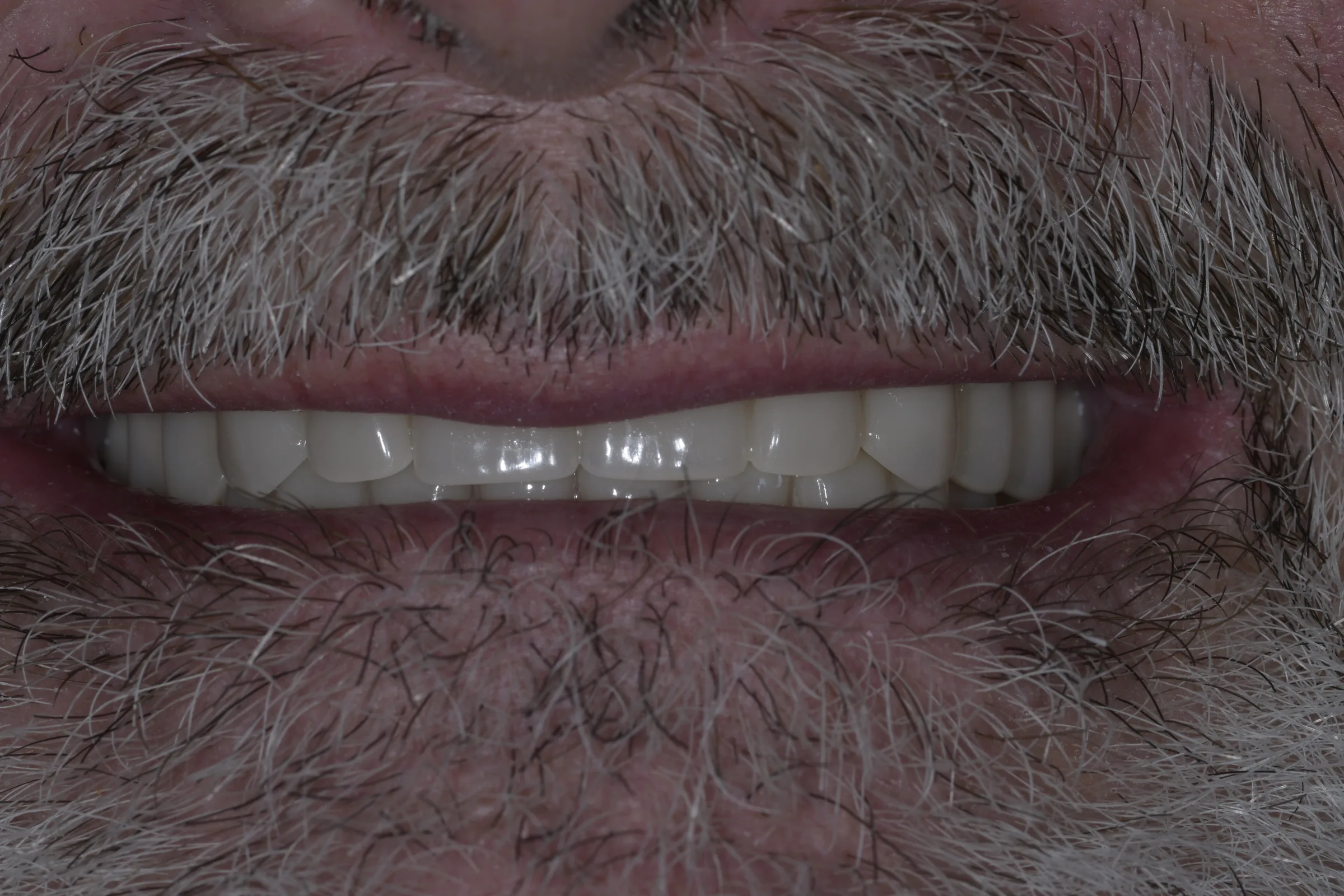
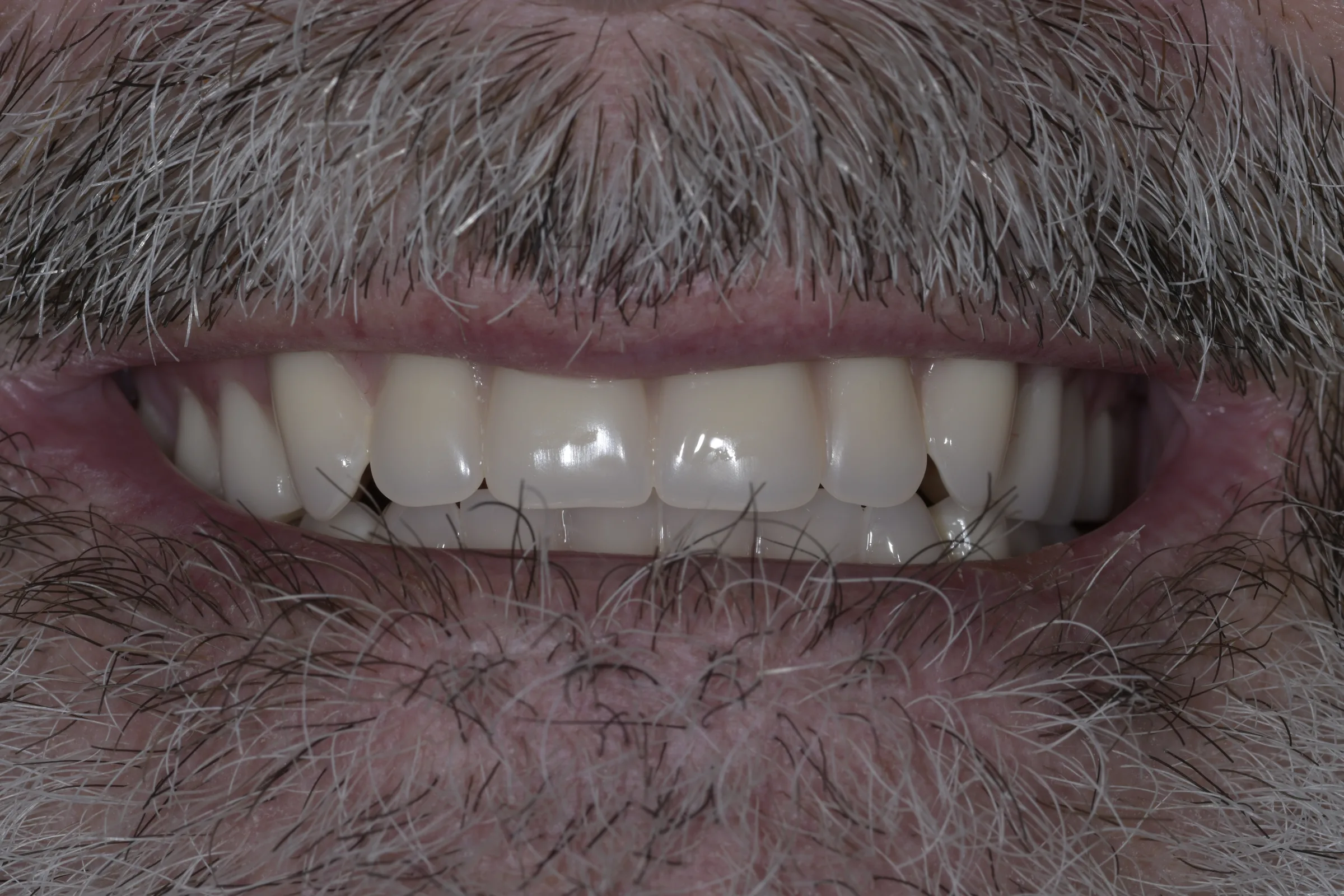
New Snap-On Set Over Existing Implants
Patient's old dentures were worn down and esthetically poor. A new set was made to clip onto the existing dental implants — improved fit and appearance without re-doing the implant work.
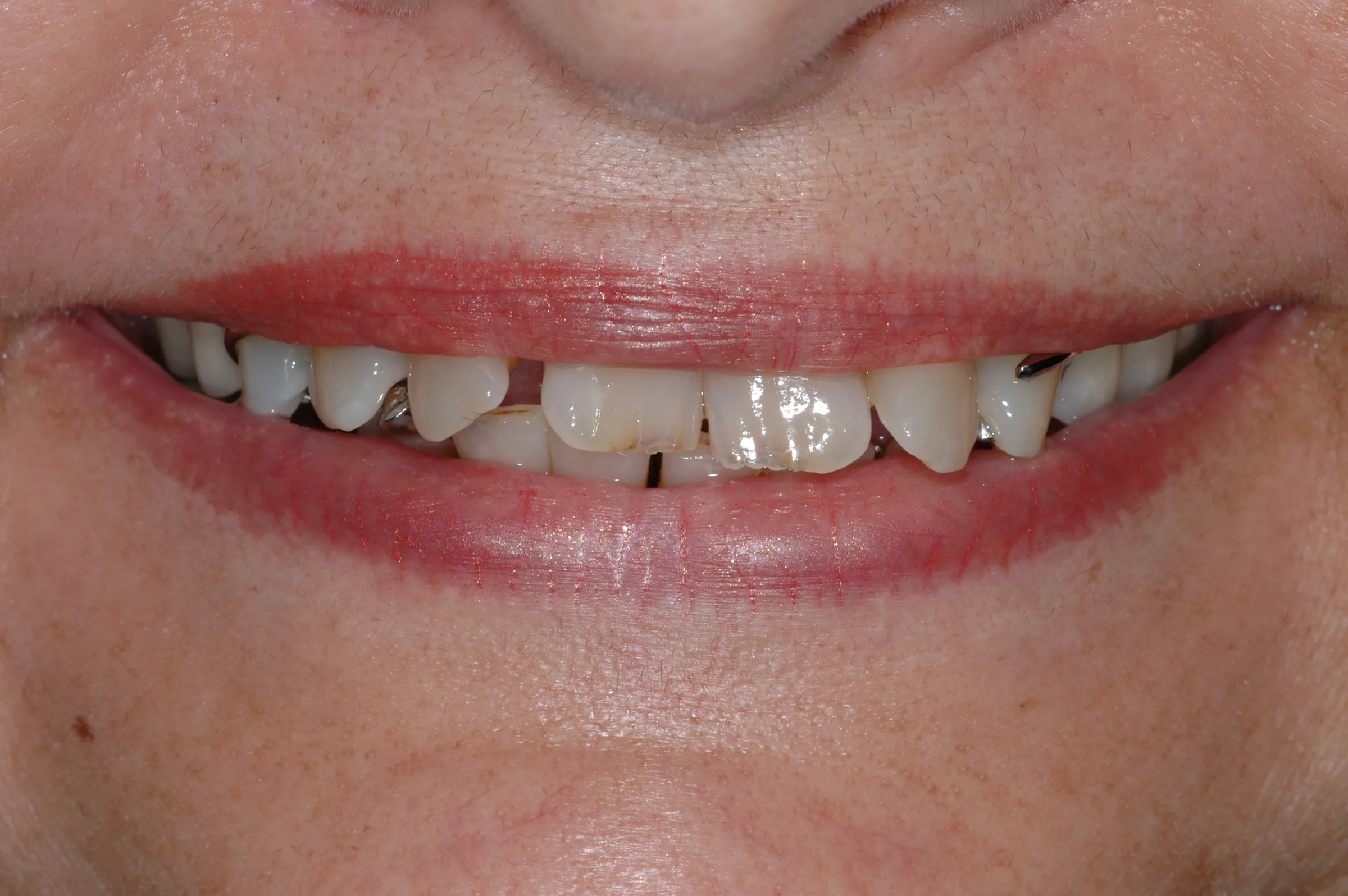
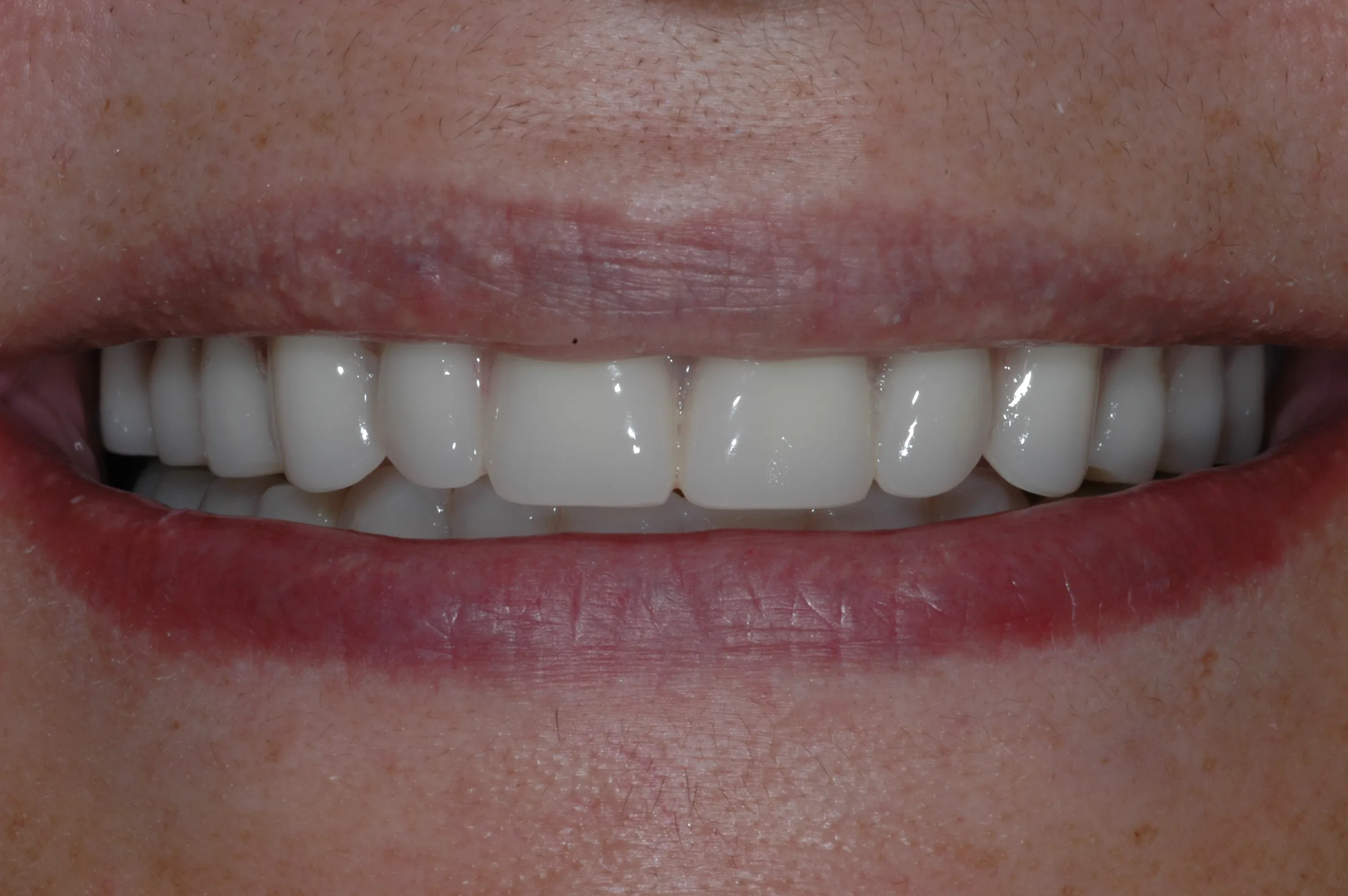
Combination Upper + Snap-On Lower
Patient had periodontally mobile teeth that couldn't be saved. Treated with a removable upper denture + an implant-retained lower snap-on denture — different solutions for each arch in one coordinated plan.
The Range of Snap-On Denture Options
The right snap-on solution depends on bone availability, denture stability needs, whether an existing denture can be converted, and the long-term goals for retention, comfort, and function.
A common starting point for lower denture stabilization. Two strategically placed implants help reduce movement and improve retention while keeping treatment more conservative than full fixed implant reconstruction.
When greater stability and retention are needed, four implants connected by a custom bar provide stronger support and improved function for a removable overdenture.
In some cases, a well-fitting existing denture can be modified and converted into an implant-retained overdenture rather than fabricating an entirely new prosthesis.
Although less common than lower overdentures, implant-retained upper dentures can improve stability and retention when anatomy, bone volume, or treatment goals make a removable solution more appropriate than a fixed full-arch restoration.
Strong, Lifelike Materials
"The implants make sure the denture doesn't move or shift unexpectedly," says Dr. Andrus, "and they enable much greater chewing power."
Made of strong, lifelike materials such as high-impact reinforced denture acrylic, the replacement teeth Dr. Andrus designs fit perfectly and look natural.
If a patient likes their current denture and it's in good shape, Dr. Andrus can often retrofit it to become a snap-on denture.

How a Snap-On Denture Case Is Performed
The first phase plans and places the implants that will hold the denture:
After placement you wear your existing denture (or a temporary one) so you're not without teeth during healing.
Over the next three to four months the implants integrate with the surrounding bone — a process called osseointegration. What this means: the bone grows around the implant and locks it permanently in place, providing the foundation that lets the denture clip on with a firm hold. During this phase you continue wearing your temporary denture and come in for short check-ups so we can confirm healing is progressing as expected.
Once the implants are integrated, attachments are added to your denture (or a new denture is fabricated) to clip onto the implants. The fit is checked and refined — the denture should clip on firmly, stay put through eating and talking, and pop off easily for cleaning. We walk you through how to seat and remove it, how to care for the attachments, and what to expect during the adaptation period.
Materials & Technology
Preparation & Sedation
Your first appointment is a comprehensive consultation: medical and dental history, CBCT imaging, an examination of any existing denture and the supporting tissue, and a long conversation about your goals.
For implant placement appointments, sedation options include:
For patients with significant dental anxiety, we walk through the visit step-by-step beforehand — so the experience feels predictable rather than overwhelming.
What Sets Dr. Andrus Apart
Dr. Andrus is a Diplomate of the American Board of Prosthodontics and a Fellow of the American College of Prosthodontists, with three years of full-time specialty residency at the University of Iowa specifically focused on restoring and replacing teeth — including implant-retained prosthetics.
Dr. Andrus has published peer research on implant superstructures for the completely edentulous (Journal of Dental Technology, 2011) — the engineering of implant-supported restorations like snap-on dentures and full-arch prostheses. Few prosthodontists have the same depth of academic engagement with this work.
Implant placement is planned in 3D using cone beam CT (CBCT) imaging and digital scanning before surgery — so the implants land exactly where the denture's snap mechanism needs them. "We don't make cookie-cutter teeth," Dr. Andrus says.
Real Snap-On Denture Patients

I'm able to eat good food — salads, nuts, corn on the cob — all those things you need teeth for.
— Charles, snap-on denture

My teeth were in terrible condition; now, I have a better smile and I'm able to eat better.
— Barry, snap-on dentures
Follow-Up & Long-Term Care
Most patients return for one or two short adjustment visits in the first month while the gums and bite settle in around the new attachments. After that, you're on a normal recall schedule of 6 to 12 months for evaluation of the implants and surrounding gum tissue, and a check of the snap attachments themselves.
At home, take the denture out at night and clean it daily with a denture brush and a non-abrasive cleaner. Brush the implants and the gums around them like natural teeth. The rubber attachments inside the denture (the part that grips the implants) wear gradually with daily use and need replacement every 12-24 months — a quick in-office step that keeps the snap firm.
With consistent home care and routine recall, the implants themselves are typically maintenance-free and can last a lifetime. The denture portion lasts five to ten years before replacement is needed — longer than a conventional denture because the implants stabilize the underlying bone and slow the ridge changes that normally limit a denture's lifespan. Plan on changing the plastic retention clips or o-rings every 1–2 years.
Dr. Andrus Answers
A regular denture rests on the gums and is held in place only by the shape of your ridge plus a thin film of saliva. It can slip when you chew tougher foods, when you talk, or when you laugh — especially the lower denture, where there's less ridge to hold it. A snap-on denture solves that. Two or more dental implants are placed in your jaw, and the denture has matching attachments that clip onto them. The denture stays anchored during use but pops off easily when you want to clean it.
Most patients with adequate jawbone are candidates. The diagnostic workup checks bone height and width, gum health, and the position of nerves and the sinuses. Patients with limited bone may need bone grafting first, or may be better candidates for a fixed full-arch implant prosthesis (all-on-4) or a more traditional denture. The consultation answers candidacy definitively.
Most cases run three to six months from implant placement to final snap-on connection. The timeline includes the implant placement appointment, three to four months of healing while the implants integrate with the bone (osseointegration), and a final visit to attach the snap mechanism to your denture. During healing you wear a temporary version of your denture so you're never without teeth.
Yes — and that's the main reason most patients choose them over conventional dentures. Implant-retained snap-on dentures restore close to natural chewing force; conventional dentures restore about 25-40% of natural bite force. Charles, a snap-on denture patient at the practice, put it this way: "I'm able to eat good food — salads, nuts, corn on the cob — all those things you need teeth for."
If your current denture is in good shape and fits well, it can often be retrofitted into a snap-on. Dr. Andrus places the implants and adapts the existing denture — so you keep the look and feel you're already comfortable with. If the denture is older, worn, or no longer fitting your ridge correctly, a new denture is usually the better answer.
Take the denture out at night, brush it daily with a denture brush and a non-abrasive cleaner (regular toothpaste is too harsh for denture acrylic), and soak it overnight to keep it moist. Brush the implants and surrounding gums like natural teeth (again, not with toothpaste, but with mouthwash). The rubber attachments inside the denture (the part that clips onto the implants) wear over time and need replacement every 12-24 months — a quick in-office step.
Snap-on dentures cost more than a conventional denture because of the implants and the attachment hardware, but less than a full-arch fixed prosthesis. After the diagnostic workup we provide a written treatment plan with the exact cost before any work is started. Financing is available through Mountain America Credit Union, CareCredit®, and Proceed Finance.
We offer both surgical and effective non-surgical options — not a one-size-fits-all approach.
Say No to Loose Dentures