Friendly, Compassionate Care

Sedation Dentistry

Comfortable care for anxious patients, long surgical phases, and complex full-mouth cases — led by a board-certified prosthodontist with USAF-accredited IV-sedation training.

When the Visit Itself Is the Problem

A Friendly, Caring Approach

If the thought of dental work makes you anxious — if you've avoided treatment for years because the appointment itself is the obstacle — if you have a strong gag reflex, a history of bad experiences, or you simply can't sit still for long visits — sedation dentistry is the path forward.

Dr. Andrus and his staff are committed to patient comfort, and they go out of their way to make sure patients feel at ease for their care. They are known for their friendly and caring chairside manner, and they always take the time to fully explain patients' options and treatments and to answer any questions they have.

For patients who need it, the practice offers a range of sedation options — from drug-free anxiety reduction through pre-appointment planning, all the way to IV sedation and an in-house CRNA / dental anesthesiologist for the most complex cases.

Dr. Andrus reviewing treatment details with a patient on an iPad chairside
Sedation starts before the medication does — with a clear, deliberate walkthrough of the visit.

Sedation & Comfort Options

Sedation Approaches for Different Levels of Anxiety and Treatment Complexity

The appropriate level of sedation depends on the procedure being performed, medical history, treatment length, anxiety level, and overall patient comfort needs. Most patients fall somewhere along a spectrum — from simple relaxation techniques to advanced anesthesia support for complex surgical care.

Iatrosedation (Drug-Free Anxiety Reduction)

Not every patient requires medication. Dr. Andrus emphasizes communication, predictability, pacing, and pre-appointment planning to reduce anxiety through understanding and trust before treatment even begins.

Oral Conscious Sedation

Medication taken before the appointment helps patients remain awake but deeply relaxed during treatment. Commonly used for moderate dental anxiety, longer restorative visits, strong gag reflexes, or patients who struggle with traditional dental appointments.

IV Conscious Sedation

Medication delivered through an IV allows sedation levels to be adjusted continuously throughout treatment. Frequently used for surgical procedures, implant placement, full-arch treatment, and patients with significant dental anxiety.

In-House CRNA & Dental Anesthesiology Support

For medically complex patients or advanced surgical rehabilitation, the practice coordinates dedicated anesthesia services through in-house CRNA and dental anesthesiology support to provide an additional level of monitoring and patient safety.

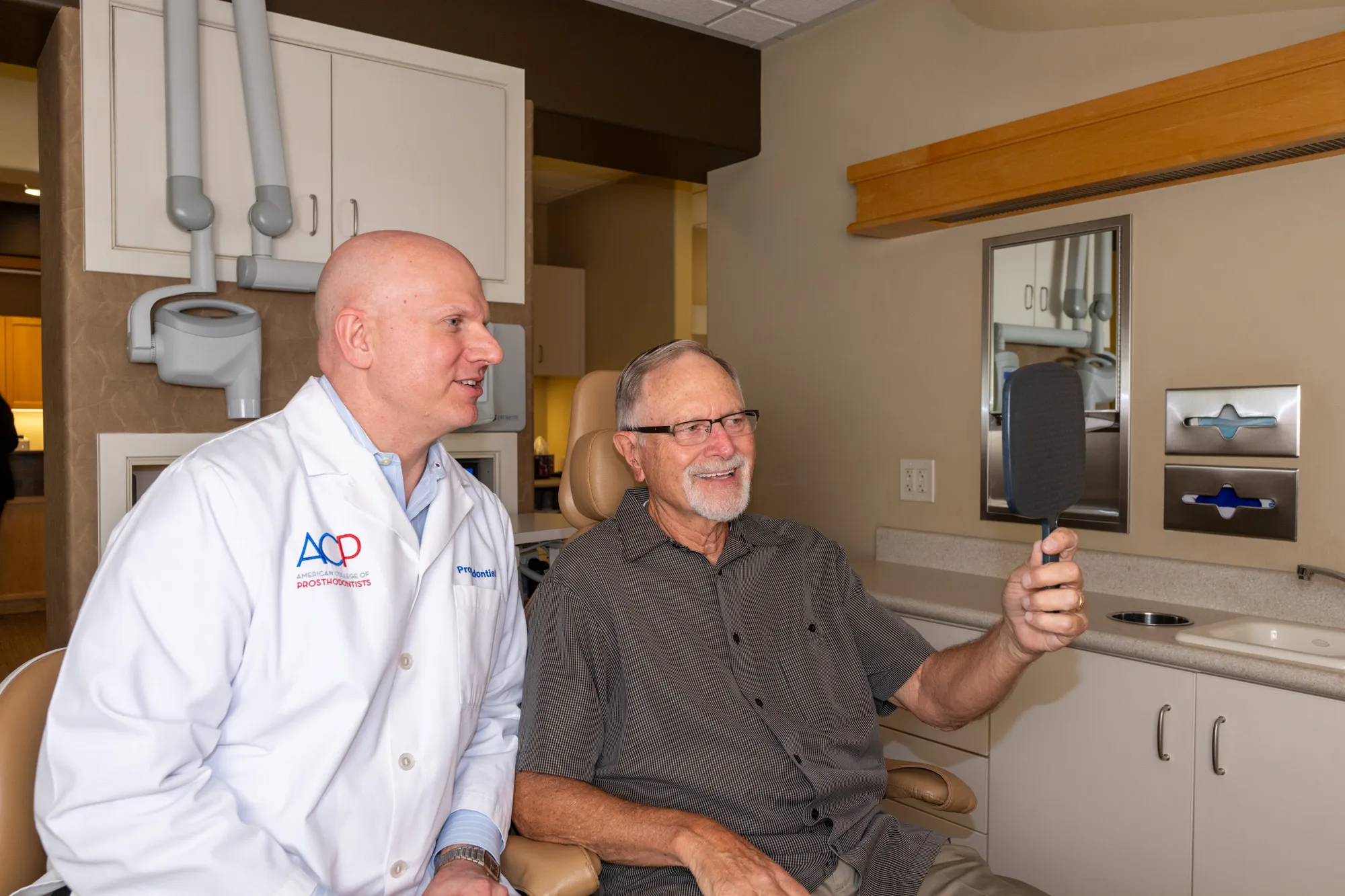
We also offer small comfort touches like weighted blankets and the option to break treatment into shorter visits when that's a better fit for the patient.

How Sedation Works at This Practice

Three Phases — Planning, Procedure, Recovery

Phase 1 — Pre-Appointment Planning

Sedation starts before the medication does. At your consultation we review:

  • Your medical history, current medications, and any prior dental-anesthesia experiences.
  • Which sedation level fits the procedure and your anxiety level.
  • What the visit will look like step-by-step — so the day-of feels predictable, not surprising.
  • Pre-procedure instructions (no eating before IV sedation, arrange a driver, what to wear, what to bring).

This is what dentists call iatrosedation — the drug-free piece of anxiety reduction. For some patients it's all that's needed.

Phase 2 — The Sedation Visit

On the day of treatment, sedation is administered per the agreed plan — a pill on arrival for oral sedation, an IV line in the arm for IV sedation, or care from the in-house anesthesiologist for the deepest levels. Throughout the procedure, vital signs are monitored continuously (pulse oximetry, blood pressure, heart rate). Most patients describe the experience as feeling like the appointment was much shorter than it actually was.

Phase 3 — Recovery & Post-Op

After the procedure, you stay in the recovery area until you're alert enough to be discharged with your driver. Written post-op instructions cover what to expect for the next 24 hours (drowsiness, food/medication restrictions, when sedation effects fully clear). For oral sedation patients, a follow-up call the next day confirms you're feeling well. For IV sedation patients, a clinic check-in within the first week is standard.

What Sets Dr. Andrus Apart

Advanced Sedation Training with a Patient-Centered Approach

USAF-Trained in IV Sedation

Dr. Andrus completed the U.S. Air Force Advanced Education in General Dentistry residency at Eglin Air Force Base, which included formal hospital-based training in IV sedation, nitrous oxide/oxygen sedation, and TMJ treatment.

Pre-Appointment Planning

For patients with significant dental anxiety, the practice walks through the appointment step-by-step before treatment begins — explaining what to expect, how sedation works, and how the visit will progress. The goal is to replace uncertainty with predictability and control.

Specialty-Level Safety Standards

Sedation protocols, monitoring procedures, recovery systems, and discharge standards follow the same structured safety principles used in hospital-based surgical environments.

Kellie Fairbanks, patient at St. George Center for Specialized Dentistry
Dr. Andrus takes pride in what he does. His quality of work is remarkable.
— Kellie Fairbanks

Dr. Andrus Answers

Your Questions About Sedation Dentistry

What is sedation dentistry?

Sedation dentistry uses medication to help anxious patients relax during dental procedures. It ranges from light sedation (a pill that makes you drowsy) all the way to deep sedation (delivered by an anesthesiologist). For most patients, a moderate level — oral conscious sedation or IV conscious sedation — is more than enough for any dental treatment, including full-arch implant work.

Am I a candidate for sedation?

Most adults are candidates. We review your medical history, current medications, and any prior reactions to dental anesthesia at the consultation. Patients with significant medical complexity (heart conditions, sleep apnea, certain medication interactions) may need additional medical clearance or may be better candidates for the in-house CRNA / dental anesthesiologist option.

Will I be unconscious during the procedure?

Not with oral or IV conscious sedation. You'll be deeply relaxed but able to respond to questions and follow instructions. Most patients have little or no memory of the procedure afterward — that's normal and expected. For deeper sedation (general anesthesia), the in-house dental anesthesiologist handles the medication while Dr. Andrus focuses on the dentistry.

How long does the sedation last?

Oral sedation effects typically last 4-6 hours. IV sedation effects wear off faster (within 1-2 hours of stopping the medication) but you'll feel groggy for several hours afterward. Plan to spend the rest of the day at home with someone available to help — no driving, no operating machinery, no major decisions until the next morning.

Is sedation safe?

Yes — with the right protocols. We follow all local, state, and OSHA standards for sedation administration: pre-sedation medical clearance, intra-operative monitoring (pulse oximetry, blood pressure, heart rate), reversal medications on hand, and post-sedation discharge protocols. The biggest risks come from skipping pre-appointment planning or ignoring patient medical complexity — neither of which we do.

What about patients with extreme anxiety?

Patients with significant dental anxiety often benefit most from a combination: pre-appointment iatrosedation (the planning conversation), oral sedation the morning of the visit, and IV sedation during the procedure itself. The pre-appointment piece is often the most underestimated — knowing what's going to happen reduces anxiety dramatically before any drug is administered.

Anxious About Dental Treatment?

Sedation Dentistry Makes the Visit Possible

Schedule a comprehensive oral evaluation with Dr. Andrus. We'll talk through your concerns, review the right sedation level for your case, and walk you through the visit step-by-step before any treatment begins.

Doctor reviewPENDING